Weather Live - Forecast&Alert
- 3.9
- Rating
- 500.00K
- Installs
- Free
- Price
 Analysis by App-foxy
Weather Live - Forecast&Alert is the kind of weather app I would keep installed for one practical reason: it puts short-term conditions and alerts in one place without asking me to treat weather checking like a separate task. The focus is clear in its name and store summary, but the useful question is how that focus affects an ordinary day. In my experience, the answer depends less on wanting a pretty forecast and more on whether you need quick decisions about leaving home, changing plans, or watching conditions over the next few hours.
Developed by DailyBetter Labs, this free weather app is aimed at everyday users rather than specialist forecasters. It is rated for Everyone, runs on Android 7.0 or later, and has reached over 100 thousand installs. Its current version is 1.6.02, while the app itself was released on February 7, 2025. Those details place it in the accessible, relatively new part of the weather-app market, so I approached it as a practical tool for routine checks rather than a replacement for professional meteorological services.
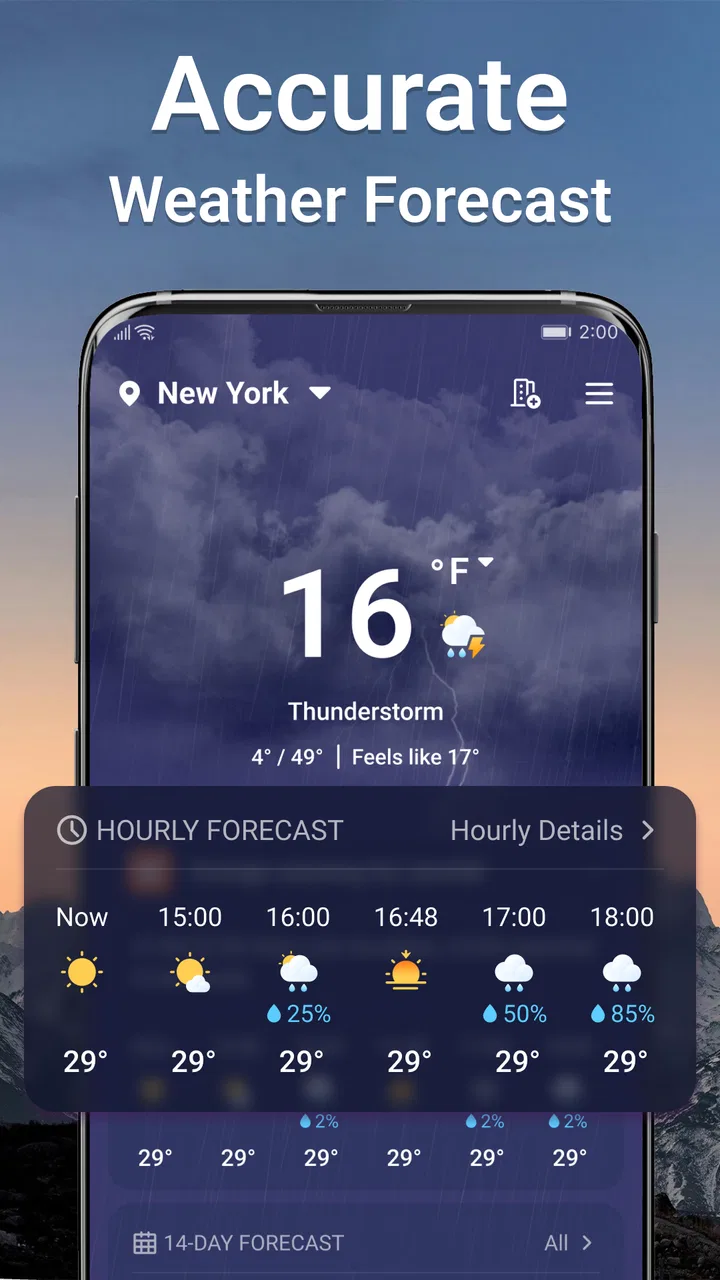
The central capability is the combination of a 24-hour forecast, a 14-day outlook, and real-time alerts. That combination sounds familiar because many weather apps offer some version of it, but the distinction is in how I use each time range. The hourly view helps with decisions I need to make today. The longer view is useful for planning, although I treat it as a broad indication rather than a promise. Alerts matter when I do not want to keep opening the app repeatedly to see whether conditions have changed.
You May Also Like

 Blood Strike: 2.5 Anniversary
Blood Strike’s Loadouts Turn Every Drop Into a Tactical Gamble
A close look at Blood Strike’s custom loadouts: how fast access to signature weapons reshapes its battle royale rhythm, rewards preparation, and narrows the gap between fights.

 Pandora - Music & Podcasts
Pandora’s Music Is Easy to Start, but Harder to Recover
Pandora’s strength is its low-effort path from a seed to a station. Its weak spot is how much confidence it asks you to place in connection, setup, and quiet recovery.

 8 Ball Pool
 Is Built on Rivalries, Rematches, and Routine
A close look at the rivalries, rematches, shared routines, and unanswered safety questions that turn a quick pool match into a persistent mobile community.

 Samsung Music
’s Quiet Strength Is Playing What You Already Own
Its reach comes less from spectacle than from dependable access to a personal library. That simplicity is both the app’s strongest retention engine and its ceiling.

 AccuWeather: Weather Radar
AccuWeather Review: A Quick, Clear Forecast for Everyday Decisions
For everyday plans, the best forecast is the one you can understand quickly. AccuWeather makes rain timing, radar, and local conditions easy to act on, with a few trade-offs.

 Hill Climb Racing
Why Hill Climb Racing Still Turns Crashes Into One More Run
A tiny car, a bumpy hill and one more upgrade: Hill Climb Racing keeps resurfacing because its simple chaos makes every near-miss feel personal.
More From Our News Desk



Why the alert-centered approach matters
Most people do not need a weather app open all day. They need an answer at a few specific moments: Is it safe to walk now? Should I take an umbrella? Will the temperature drop before I return? Is an outdoor plan becoming uncomfortable or impractical? Weather Live - Forecast&Alert is most convincing when it reduces those repeated checks.
The real benefit of an alert is not that it makes the forecast more accurate by itself. It changes the timing of the information. Instead of remembering to check the app before every trip outside, I can use the alert function as a prompt to pay attention when conditions become relevant. That is especially useful for people whose plans are flexible but whose time is not. A commuter, parent, dog owner, cyclist, or delivery worker can make better use of a timely warning than of a beautifully arranged forecast that is never opened.
I also like the way the two forecast horizons serve different kinds of thinking. The 24-hour view is where I would look for a morning commute, a lunch break, an evening walk, or a trip home. The 14-day view is better for spotting patterns around a future plan, such as whether a weekend appears unsettled or whether a cooler period may be approaching. I would not use the distant view to make a rigid decision, but it can tell me when I should wait before committing.
The strongest part of this app is not simply showing more weather information; it is helping me decide when I need to look again. That is a small change in workflow, but it is more meaningful than adding another decorative weather screen.
Using the short forecast for decisions, not decoration
When I open the app for a same-day decision, I focus on the sequence of conditions rather than one headline temperature. A morning that begins dry may become inconvenient later, and a cool-looking day may still feel manageable if the worst period falls while I am indoors. The 24-hour forecast is therefore most useful when I compare it with my schedule instead of reading it as a single daily label.
A practical habit is to check the forecast twice for an important outing: once when making the plan and again shortly before leaving. The first check tells me whether the plan looks reasonable. The second check gives the alert system and the latest forecast a chance to influence the final choice. This is where the app’s real-time emphasis makes sense. Weather changes are easier to act on when the information arrives close to the moment it matters.
The longer outlook needs a different mindset. I use the 14-day forecast to identify uncertainty, not to pretend that I know the exact conditions far in advance. If several future days look broadly similar, I might choose one for a casual plan. If the outlook shifts noticeably, I would keep the plan flexible and check again later. That approach prevents one of the most common mistakes with extended forecasts: treating a distant estimate as a fixed appointment with the weather.
A realistic day with Weather Live - Forecast&Alert
Imagine a weekday when I need to walk to a station in the morning, spend part of the afternoon outside, and return home after sunset. I would first use the 24-hour forecast to see whether the difficult part of the day is likely to overlap with those journeys. If the app sends an alert later, I can change the order of errands, carry suitable clothing, or choose a different way to travel instead of discovering the change at the door.
The 14-day view becomes useful earlier in the week. If I am considering an outdoor appointment for the following weekend, I can look for a more promising window without assuming that the forecast is settled. I would then revisit the app closer to the date. This two-stage workflow is more sensible than relying on either a long-range forecast alone or a last-minute check with no preparation.
For a dog owner, the same pattern can be even more practical. A short forecast can help decide whether a longer walk belongs in the morning or evening, while an alert can serve as a reminder that conditions have changed. For a cyclist, the app can support route timing, but I would still make a separate judgment about visibility, road safety, and local conditions. The app can inform a decision; it should not replace common sense.
Where the app fits beside familiar alternatives
Compared with a basic phone weather widget, Weather Live - Forecast&Alert offers a more deliberate place to review both immediate and extended conditions. A widget is excellent when I only want a glance at the current situation. This app makes more sense when I want to examine the day ahead, consider a future plan, and receive alerts rather than depend entirely on memory.
Compared with a highly technical weather service, it is better suited to people who want understandable planning information without building a forecast around specialist charts. Users who need detailed radar interpretation, aviation-oriented information, or professional-grade local analysis may prefer a dedicated service designed for those tasks. I would not choose this app as my only source for serious weather risk, remote travel, or work where a missed warning could have major consequences.
Its position is therefore fairly clear. It is more useful than a glance-only widget, but less appropriate than a specialist platform for advanced weather analysis. That middle ground is not a weakness by itself. It becomes a weakness only when someone expects the app to serve a purpose it was not designed to handle.
The practical tradeoffs behind alerts
Alerts are helpful because they interrupt my routine, but interruption is also their main tradeoff. A person who enables every possible notification may find the app more distracting than useful. I would start with only the alerts that relate to decisions I genuinely make, then adjust my habits after a few days. A warning that arrives too often loses its importance, while one that is connected to a real plan is easier to notice.
There is also a judgment issue. An alert can tell me that conditions deserve attention, but it cannot understand whether I am indoors, already carrying what I need, or traveling somewhere with different local circumstances. I still have to interpret the message. This is why I see alerts as a safety net for attention, not as automatic instructions.
Another tradeoff comes from the difference between a forecast and an observation. A current condition can change before I reach my destination, and a forecast can be revised as new information becomes available. The app is most useful when I treat its information as a current planning aid. I would not blame it for every mismatch between an estimate and what happens outside; weather forecasting is inherently uncertain, especially as the time horizon grows.
What the free installation really means
The app is free to install, which makes it easy to try without committing money first. It also includes in-app purchases ranging from $1.99 to $9.99 per item. That matters for anyone who wants to keep the experience entirely free: I would check which parts of the app remain available without purchasing before making it my only weather tool.
This pricing structure does not automatically make the app poor value. A free version can be enough for someone who mainly wants a daily forecast and occasional alerts, while optional purchases may suit users who want more from the experience. Still, I prefer to decide based on actual use rather than assume that every useful function is included. If I only open a weather app twice a day, paying for extra convenience may not be worthwhile. If alerts become part of my daily planning, the value calculation changes.
The age rating of Everyone also makes it approachable for households with different users. That does not mean every family member will want the same level of information. A child may only need a simple answer about rain or temperature, while an adult may use the longer outlook to organize travel. The app’s broad accessibility is helpful, but it does not remove the need for an adult to interpret severe or uncertain conditions responsibly.
Small habits that make the app more useful
My first tip is to connect the forecast to a specific decision. Instead of opening the app without a question, I would ask, “What will affect my next trip outside?” This keeps the 24-hour view from becoming endless scrolling and makes the alert feature easier to evaluate.
My second tip is to use the 14-day forecast as a planning filter. I would not choose a date solely because it appears favorable far ahead. I would use it to identify two or three possible windows, then return closer to the event. This turns a potentially misleading long-range view into a flexible planning tool.
My third tip is to review alerts after they arrive rather than reacting automatically. If an alert changes my plan, I would compare it with the rest of the day’s forecast and the practical details of my route. That extra moment helps avoid overreacting to a notification that may be irrelevant to my exact situation.
A fourth useful habit is to compare the app’s information with what I can observe locally when conditions are changing quickly. A sheltered street, exposed hill, coastal area, or dense city block can feel different from a general forecast location. Weather Live - Forecast&Alert can guide attention, but my surroundings remain part of the evidence.
Who will get the most from it
I think this app is a good fit for someone who wants one uncomplicated place to check today’s weather, glance ahead, and receive timely prompts. It should appeal particularly to people with changing routines: commuters, parents arranging outdoor activities, walkers, casual travelers, and anyone who often realizes too late that the weather has shifted.
It is also a sensible choice for users moving away from a minimal widget but not ready for a technical weather platform. The 24-hour and 14-day views create a useful bridge between instant information and future planning. The app’s 4.2 average from over 500 ratings suggests a generally positive reception, and its review count gives prospective users some indication that it is being actively tried rather than existing only as an obscure download.
I would skip it if I need specialized forecasting tools, extremely detailed local analysis, or a completely notification-free experience. I would also hesitate to rely on it alone for hazardous conditions, long expeditions, or professional decisions. In those cases, a specialist source and official warnings should take priority.
My final take after using its core workflow
Weather Live - Forecast&Alert works best when I use it as a decision assistant rather than as a screen to admire. Its strongest idea is the connection between the immediate forecast and alerts that can bring changing conditions back to my attention. The extended outlook adds planning value, provided I respect its uncertainty and check again before an important event.
DailyBetter Labs has made a free weather app that sits comfortably between a basic widget and a professional forecasting service. The in-app purchase range means I would inspect the free experience before paying for anything, and the alert system deserves thoughtful setup so it remains useful instead of noisy. Those are real considerations, but they do not undermine the main workflow.
My recommendation is straightforward: try it if your main problem is remembering to check the weather before plans change. Keep it as a convenient everyday guide, use the 24-hour view for immediate choices, use the 14-day view for flexible planning, and treat alerts as prompts to reassess rather than commands. For that audience, Weather Live - Forecast&Alert offers a practical balance of convenience and foresight without forcing everyday users into a technical forecasting routine.
FAQs for Weather Live - Forecast&Alert
01What features does Weather Live - Forecast&Alert offer?
Weather Live - Forecast&Alert provides a comprehensive set of features including real-time weather updates, hourly and 7-day forecasts, severe weather alerts, and interactive radar maps. The app also includes widgets for quick access, sunrise/sunset times, and customizable alerts to keep you up-to-date with changing weather conditions.
02Is Weather Live - Forecast&Alert available for both Android and iOS?
Yes, Weather Live - Forecast&Alert is available for download on both Android and iOS platforms. You can find it on the Google Play Store for Android devices and the Apple App Store for iOS devices, ensuring a seamless experience across different operating systems.
03Does Weather Live - Forecast&Alert require a subscription?
Weather Live - Forecast&Alert offers both free and premium versions. While the free version provides basic features, the premium subscription unlocks additional benefits such as ad-free usage, advanced radar features, and more detailed forecasts. Users can choose the plan that best suits their needs.
04How accurate is the weather information provided by Weather Live - Forecast&Alert?
Weather Live - Forecast&Alert uses data from reliable meteorological sources to provide accurate weather information. The app is designed to deliver precise forecasts, though users should be aware that no weather app can guarantee 100% accuracy due to the ever-changing nature of weather conditions.
05Can I customize notifications in Weather Live - Forecast&Alert?
Yes, Weather Live - Forecast&Alert allows you to customize notifications to suit your preferences. You can set alerts for severe weather conditions, daily forecasts, and specific weather changes. This feature ensures that you receive timely information relevant to your location and needs.
Pros
- Accurate and real-time weather updates.
- Customizable weather widgets available.
- Global weather coverage
- city-specific.
- Severe weather alerts for safety.
- User-friendly interface design.
Cons
- Contains in-app advertisements.
- Some features require premium.
- Battery usage can be high.
- Occasional lag in widget updates.
- Limited offline functionality.

Weather Live - Forecast&Alert
Gallery